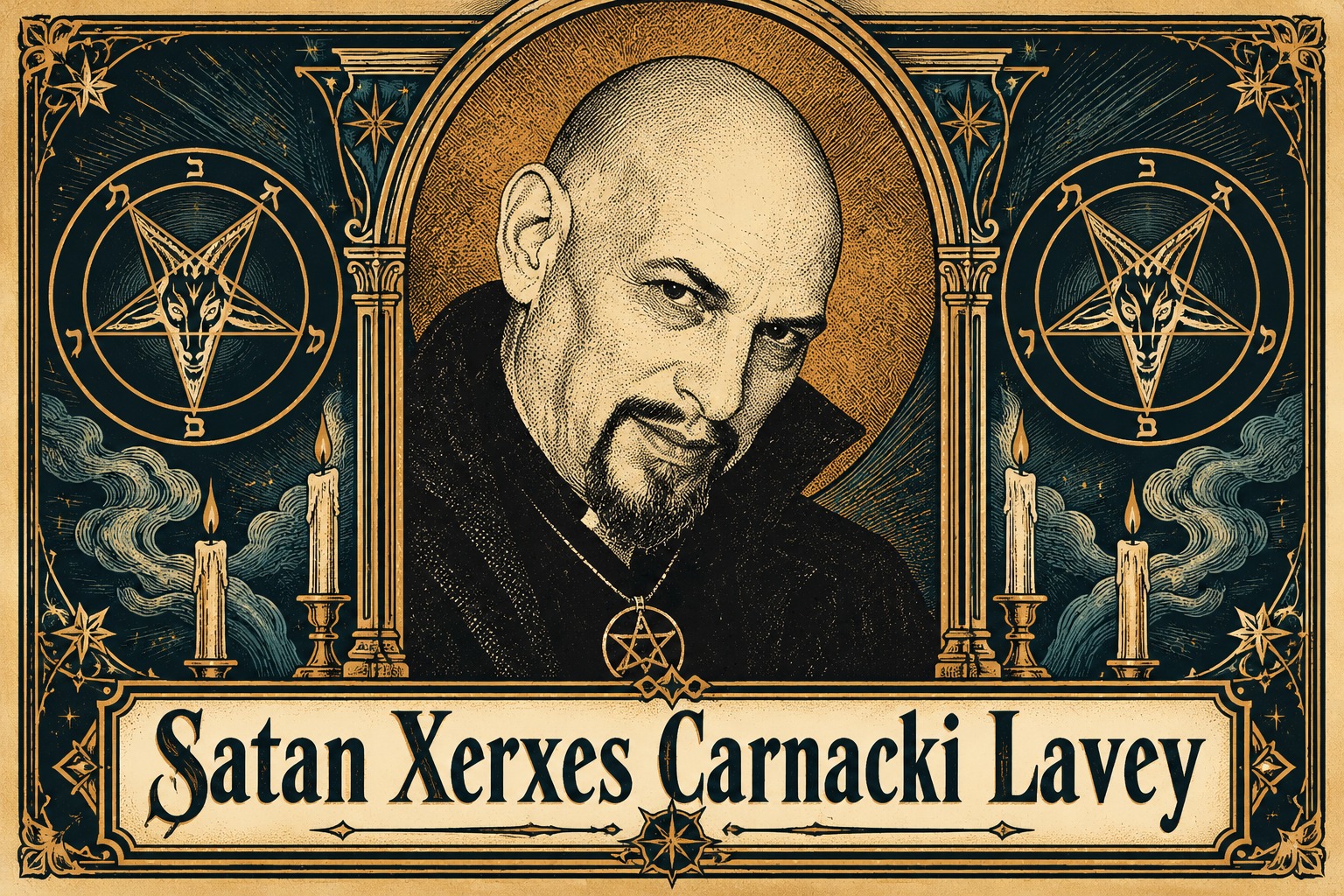
A son born late in his father’s life
Satan Xerxes Carnacki Lavey, often called Xerxes LaVey, is the only son of Anton Szandor LaVey and Blanche Barton. He was born in 1993, near the end of his father’s life, and was still a young child when Anton died in 1997. His public identity is consequently tied to a family history that began decades before his birth.
I find that age difference important. Anton was already known as the founder of the Church of Satan and author of The Satanic Bible. Xerxes entered an established public story, but he did not create that institution or write his father’s books. Parentage explains the attention attached to his name without establishing a public religious or professional role of his own.
Anton Szandor LaVey
Anton LaVey lived from 1930 to 1997. His public career revolved around the Church of Satan and writings associated with it. By the time his son was born, his name had been a subject of cultural interest and controversy for many years.
The relationship between father and son should remain separate from the relationship between a founder and an institution. Xerxes was a child within the household, not a successor automatically appointed by birth.
Anton died on October 29, 1997. With a 1993 birth year, Xerxes had spent only a few years with his father. The brief overlap of their lives is the central personal chronology available for this relationship. Later disputes about property and organizational control took place after that childhood loss.
Blanche Barton
Blanche Barton is Xerxes’ mother. She was Anton’s companion during his final years and held administrative and religious responsibilities within the Church of Satan. Her biography therefore connects family life with the institution that made Anton publicly recognizable.
She and Anton became companions in the 1980s, before Xerxes’ birth. Her place in the family differs from that of the mothers of Anton’s older daughters. That distinction helps explain why the three children share a father while belonging to different maternal branches.
I see Barton as a central figure in the years after Anton’s death because Xerxes was still a child. Her involvement in the subsequent estate proceedings concerned both her relationship with Anton and her role as the child’s mother. Those proceedings belong to the known history, but they do not authorize speculation about how she raised him or what his childhood felt like.
Karla and Zeena
Xerxes’ paternal half sisters are Karla LaVey and Zeena Galatea Schreck, born Zeena LaVey. Karla was Anton’s daughter with Carole Lansing. Zeena was his daughter with Diane Hegarty. Both were much older than Xerxes and already had public associations with the LaVey family before he was born.
Karla was involved in the public announcement following Anton’s death. Zeena developed her own public identity and has spoken about the family. Their different histories should not be condensed into a claim that all three children held the same position within their father’s institution.
I find the phrase half sister useful here because it is precise without diminishing the relationship. Karla, Zeena and Xerxes share Anton as their father. Their mothers are different people, and their birth dates place them at very different stages of life in 1997. The family therefore contained adult daughters and a young son when Anton died.
Grandparents and the earlier family line
Anton’s parents were Michael Joseph Levey and Gertrude Augusta Coultron. They are Xerxes’ paternal grandparents. Their place in the biography connects the public LaVey name with an earlier family generation and a different form of the surname.
A family profile can easily lose track of generations when it moves from a famous founder to his children and then to his parents. I keep the connection explicit: Michael and Gertrude were Anton’s parents, and Anton was Xerxes’ father. They are not the parents of Blanche Barton or members of a later household.
These ancestral relationships add depth to the family map without providing a full biography of Xerxes himself. The known story remains concentrated on his parents, half sisters and the events surrounding his father’s death. Earlier generations belong to the background rather than an invented account of the son’s daily life.
The estate proceedings
After Anton died, Barton presented a handwritten will that proposed placing his belongings and intellectual property in a trust for Xerxes. Karla contested that document. The dispute resulted in an arrangement dividing belongings and intellectual property among Anton’s children, while Barton retained control of the Church corporation.
I think the separation between personal estate and organizational control is especially important. Inheriting belongings or royalty interests is different from being appointed to lead a religious institution. The proceedings concerned more than one kind of asset and more than one family member.
The original handwritten document was found invalid, and the later settlement provides the relevant outcome. Xerxes’ involvement was as Anton’s young son and a beneficiary in the family arrangements. Describing him as the uncontested heir to everything Anton created would erase the dispute and the participation of his sisters.
A private adult life after a public childhood connection
The known public account describes Xerxes as living privately. It does not establish a regular public career, an official leadership position or a detailed professional record.
That narrower adult profile is meaningful in relation to the rest of the family. Anton was a highly recognizable founder, Barton held organizational responsibilities, and Karla and Zeena had their own public histories. Xerxes can be accurately identified as their relative without being given the same public role.
His biography’s firm sequence remains short but specific: birth in 1993 to Anton and Blanche, his father’s death in 1997, estate proceedings involving the family and subsequent descriptions of a private life. The dramatic name should not distract from the fact that he was a small child during the most extensively described events concerning him.
FAQ
Who are Satan Xerxes Carnacki Lavey’s parents?
His parents are Anton Szandor LaVey and Blanche Barton. Anton founded the Church of Satan and wrote The Satanic Bible. Barton was his companion in later life and held responsibilities within the organization. Xerxes was born in 1993 and was their son, rather than a founder of the institution himself.
How is Xerxes related to Karla and Zeena?
Karla LaVey and Zeena Galatea Schreck are his paternal half sisters. All three share Anton LaVey as their father. Karla’s mother was Carole Lansing, Zeena’s mother was Diane Hegarty, and Xerxes’ mother is Blanche Barton. The daughters were adults when their younger brother was born.
Did Xerxes automatically inherit leadership of the Church of Satan?
The known history does not establish an automatic leadership succession to Xerxes. The estate dispute concerned belongings and intellectual property, while control of the Church corporation remained with Barton under the described arrangements. His relationship as Anton’s son should be distinguished from an official organizational position or a public profession.